 RSS
RSS
Palmer testifies on economic stimulous package
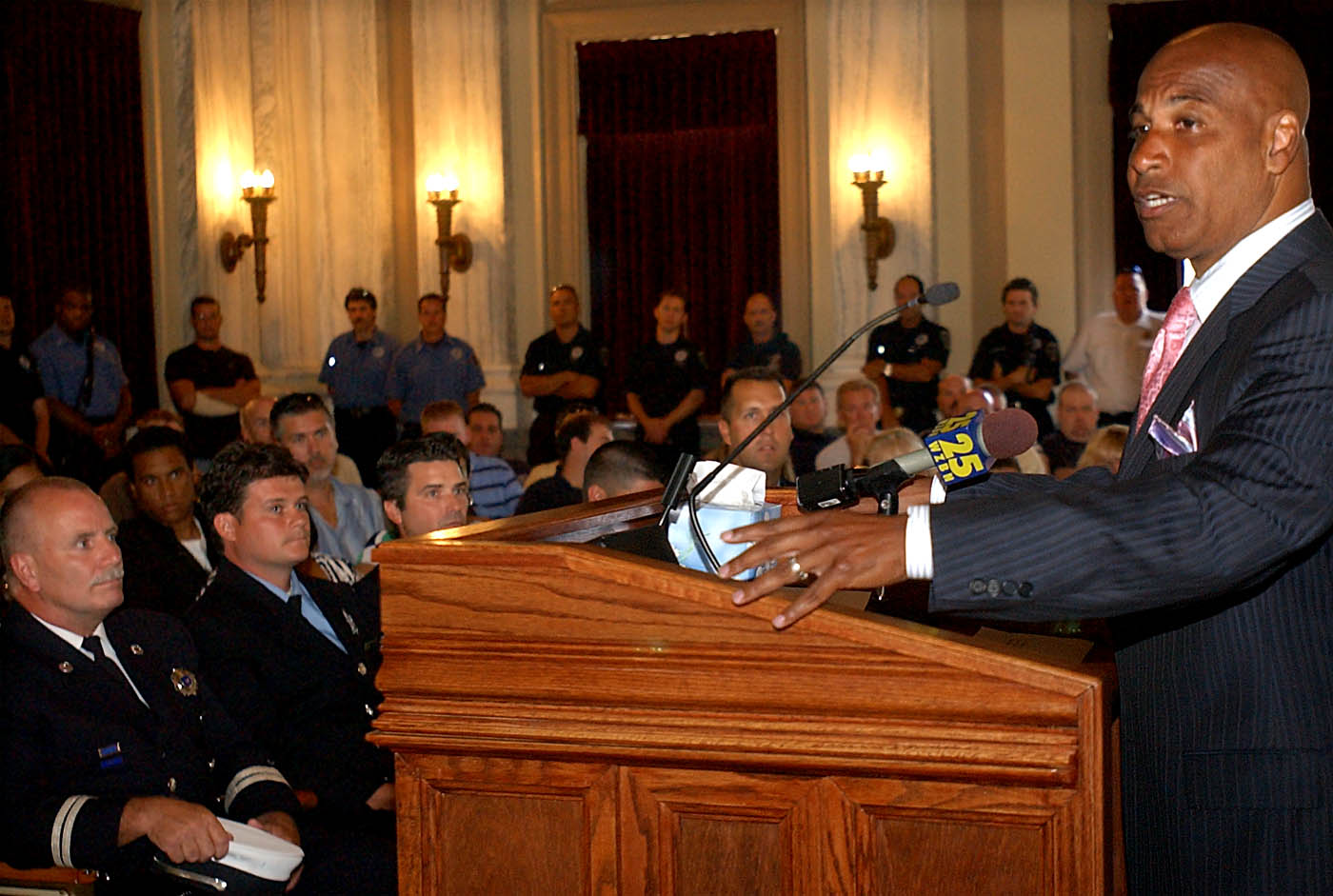 Thank you Mr. Chairman. I am Douglas H. Palmer, Mayor of Trenton and Immediate
Past President of the United States Conference of Mayors. First let me commend you for your
leadership of one of the most important committees in Congress and for your long-standing support of local governments. On behalf of the nation’s mayors, we are pleased that you care enough to hold this hearing and to focus national attention on how the economic crisis is
impacting American families and state and local governments. We also appreciate the
opportunity to discuss how cities across the nation are affected by this crisis and will offer a few
recommendations that we believe will help create jobs and restore economic stability.
As mayors, our citizens ask us every single day: What effect will the economic downturn
have on their jobs, their mortgages, their long-term savings, and their pension funds? Across our
nation, Americans have lost nearly 800,000 jobs in the last nine months. Unemployment
currently stands at 6.1 percent and is projected to reach 7.5 percent next year. Families have lost $2 trillion (20 percent) of their savings. And according to recent reports, retail sales on Main
Street have dropped 1.2 percent in September, foreshadowing a dismal holiday shopping season,
which accounts for approximately 25 percent of annual sales for most businesses.
The fiscal condition of cities has declined significantly since 2007 according to The City
Fiscal Condition Survey, an annual report published in September 2008 by the National League
of Cities. The report states that two of every three city finance officers surveyed in 2008
reported that their cities are less able to meet fiscal needs than in 2007. This compares with 70
percent last year who said their cities were better able to meet fiscal needs than in 2006. The
same report predicts a decline in all three major sources of local tax revenue: property, sales, and income taxes.
Unlike the federal government, local governments can not carry a deficit from one year to
the next. We are required by law to spend no more than we receive in revenues. As a result,
many cities are taking drastic steps to balance their budgets. Let me provide you with a few
examples.
Trenton
Starting with my own city, the financial meltdown, and the domino effect that has
occurred in other sectors, is having a profound effect on the City of Trenton as well as many
other urban municipalities and Main Streets throughout the country.
From a local perspective, Trenton is at a greater disadvantage than many. New Jersey
cities rely heavily upon property taxes as their major source of budget revenue. Cities do not
collect sales, payroll or telecommunications taxes at the local level. They are all collected by the
state. As the capital of New Jersey, Trenton has a very large number of state, county, and federal buildings, many situated on prime property overlooking the Delaware River. We are also a small city land-wise. Almost one third of our 7.5 square miles is owned by State government. Almost 53 percent of all properties are tax exempt. We rely heavily upon State aid to supplement our budget.
To make matters worse, the State of New Jersey is in a fiscal crisis. Local aid has been
reduced significantly, and it is projected that this trend will continue. It is estimated that New
Jersey will have a $4 billion deficit in the next fiscal year. This has translated into a $4.6 million
revenue reduction in State aid to us in the current budget year. In sum, the city’s budget deficit is $25.8 million. As a result, we have instituted a major workforce reduction plan, which includes
layoffs, demotions and the elimination of most personnel vacancies, including 16 police officer
and 13 firefighter vacancies and the demotion of 13 fire captains. In all, we will be eliminating
over 10% of the workforce. This will reduce budget appropriations by $7.4 million, but we will
still have to close the remaining $18.8 million shortfall. If the city cannot find a way to close
this gap, the tax rate will increase by 43 percent.
Additionally, we are struggling to grow our economy and property tax revenues. The
mortgage and credit crisis, compounded by loss of jobs and bankruptcies have resulted in a 46
percent increase in foreclosure filings in the last year. Further, we have had to grapple with the
State using large tracts of prime property for surface parking. Development of these properties
would generate millions of dollars in residential and commercial property tax revenues and spur
the local economy with construction jobs and other more permanent employment. Another major project that will spur the local economy is the redesign of Route 29, a major route along the Delaware River running through Trenton. This road is slated to be converted from a speedway to a boulevard, and in so doing, would join the city with one of its most valuable resources: developable riverfront property. Federal public works dollars would go a long way in providing the capital necessary to make this possible, creating jobs, new construction and new property tax revenues. While Trenton has been hit hard by this crisis, many other cities have also been heavily impacted.
New York
Some economists are predicting that New York and other cities with close ties to the
financial sector will probably suffer the worst. In response to dwindling revenues, New York
City Mayor Michael Bloomberg has pushed through a series of budget cuts over the last year and
a half. So far the city has cut $1.1 billion from last year’s budget, $1.3 from this year’s and $1.2
billion from next year’s. These drastic steps are being taken to close a projected budget shortfall
of $2.3 billion next year, and shortfall of $5.2 billion and $5.1 billion in the following two years.
Bracing for even further declines in revenue from the Wall Street meltdown, Mayor
Bloomberg recently ordered city agencies to come up with another $1.5 billion in cuts. If
approved by the City Council, each agency will be required to reduce its budget by 2.5 percent
this year and an additional 5 percent next year. There is no doubt many critical services will
suffer. The City Department of Education will be cut by more than $580 million. And this
comes on top of the $180 million cuts in public schools last February. The Police Department
budget will also be reduced by $286 million. In addition to the cuts, the Mayor is considering a
mid-year 7 percent increase in property taxes to help balance the budget in future years.
Chicago
The City of Chicago is facing a $469 million budget shortfall. In response, Mayor
Richard M. Daley has proposed laying off 929 city workers and eliminating 1,346 vacant jobs.
His new budget proposal also calls for increasing taxes on parking and sports tickets, and
requiring city workers to take three unpaid days off.
The City of Chicago is facing a $469 million budget shortfall. In response, Mayor
Richard M. Daley has proposed laying off 929 city workers and eliminating 1,346 vacant jobs.
His new budget proposal also calls for increasing taxes on parking and sports tickets, and
requiring city workers to take three unpaid days off.
The tax increases come on top of numerous tax increases already imposed. Mayor Daley
explained the budget cuts will mean the city will take longer to hire police officers, to plow side
streets following snow storms, to clean vacant lots and to fill potholes.
Atlanta
In Atlanta, city officials have decided to cut 130 positions in the city’s Fire Department to
help close a $140 million budget gap. Although the Fire Chief has decided not to close any of
the fire stations, firefighters are being redistributed from areas with fewer emergency calls to
areas with more calls. According to the Fire Chief, this move could increase some emergency
response times.
I am sure all will agree that our local Fire Departments provide a critical service and that
response time can make all the difference in the world when it come to saving lives and personal
property. We can only hope the budget crunch that many of our cities are experiencing will
never impede our Fire Departments’ ability to respond to life-threatening emergencies in a
timely manner.
Sacramento
With a budget shortfall projected to surpass $40 million next year due to declining
revenues from sales and property taxes, the city of Sacramento has decided to furlough 889 nonunion employees. This is about one-fifth of the city’s approximately 5,000 workforce. Most of these employees are in supervisory positions. They will be required to take one unpaid day off
per month effective January 1, 2009 and it could continue beyond six months. This will amount
to a 5 percent salary reduction for affected employees.
The cuts will mean fewer police patrols, a decrease in the number of serious crimes
detectives will respond to after hours, and it will take longer to respond to 911 calls. Although
the city is cutting back in an attempt to avoid layoffs, the City Manager has made clear that
nothing is off the table when it comes to future cuts. About 70 percent of the city’s budget goes
to pay labor costs, which makes layoffs a huge target for future cuts.
In summary Mr. Chairman, the economic meltdown sweeping across our nation and the
globe, threatens to subject many local governments to budget shortfalls far into the foreseeable
future. It is clear to us that the economy needs a shot in the arm to nurture it back to a healthy
recovery. Now that Congress has enacted a $700 billion package to bail out Wall Street, we
strongly recommend the enactment of a Main Street Stimulus package. Congress should also
take action to ensure that local governments have access to short-term credit.
Local Government Credit Assistance
Due to the problems in the domestic and global financial markets, state and local
governments are finding it increasingly difficult to access the capital markets at commonly
acceptable rates. Cities across the country are especially having difficulty selling bonds and
accessing short-term credit. State and local government issue short-term instruments for the
same reasons as corporations—to access capital to pay debts until revenues are received, or until
new bonds are issued. We are concerned about recent comments by the Federal Reserve that the newly created Commercial Paper Funding Facility (CPFF) would not assist the tax-exempt,
short-term market.
We strongly recommend that Congress direct the Federal Reserve and the Treasury
Department to work together under the $700 billion Emergency Economic Stabilization Act to
design a facility to provide a funding backstop to the state and municipal government debt
market similar to the recently announced program for commercial paper. Without such action,
states and municipalities will face ever-increasing costs to manage their short-term debt.
Main Street Stimulus
Congress should immediately enact a Main Street Stimulus package that includes
programs that will create jobs, improve the nation’s infrastructure, help small businesses on
Main Street and have a lasting economic and environmental impact. The following programs
should be included in the Main Street Stimulus package:
1. Community Development Block Grants for Infrastructure ($10 Billion)
We’re asking for a $10 billion increase in CDBG to create jobs through: the
construction and improvement of public facilities, streets, and neighborhood
centers; the conversion of school buildings; and assistance to businesses to
generate economic development and job creation.
2. Energy Block Grant for Infrastructure and Green Jobs ($5 Billion)
It is time to move America toward a greener economy and tap the potential to
create millions of green jobs for Main Street businesses and free the U.S.
economy from its dependence on foreign oil. Congress should approve a $5
billion investment in EECBG, which will give cities, counties, and states the
resources to create thousands of energy efficiency and renewable energy
production projects across the nation.
3. Transit Equipment and Infrastructure ($9 Billion)
Our rail and bus systems are being forced to raise fares, cut service, and borrow
funds to address the capital and operating needs. At the same time we are
experiencing a dramatic surge in ridership due to high gas prices. Congress
should fund the purchase of buses, street cars, rail cars and other equipment
needed to create additional capacity; help stabilize fare increases; and restore and
maintain facilities and infrastructure in a state of good repair.
4. Highway Infrastructure ($32 Billion)
To create Main Street jobs and ensure that traffic-congested areas actually receive
funding, Congress must not distribute additional highway stimulus funds based on
the current state-based status-quo system. Instead, the Surface Transportation
Program must be used to distribute highway stimulus funds. This will provide
maximum flexibility to cities, counties, and states in advancing bridge, bus and
rail, and road projects in our nation’s metropolitan areas.
5. Airport Technology and Infrastructure ($1.5 Billion)
The nation’s airport infrastructure urgently needs increased funding to begin
addressing the investment gap in airport capacity, safety and technology. To
create high-paying jobs, assist small businesses and airport retailers, Congress
should fund ready-to-go Airport Improvement projects.
6. Amtrak Infrastructure ($1.25 Billion)
Amtrak is experiencing record ridership across the railroad’s entire system for
intercity passenger rail service. Amtrak connects rural, suburban, and urban
communities in all regions of the nation. Congress should increase federal
funding to make necessary upgrades to tracks, bridges and tunnels, electric
traction, interlockings, signals and communications, and stations on the nation’s
Amtrak system.
7. Water and Wastewater Infrastructure ($18.75 Billion)
Despite the tremendous investment made by local government, the Environmental
Protection Agency estimates that there still is a $500 billion “needs gap” to meet
our water and wastewater infrastructure needs. Congress should allocate an
additional $18.75 billion directly to cities as grants to assist with rehabilitating
aging water and sewer infrastructure, complying with sewer overflow issues, and
promoting source water protection and availability.
8. School Modernization ($7.5 Billion)
America's schools are in dire need of modernization and repair. Every day, many
of our children attend school in overcrowded classrooms with faulty electrical
systems, broken windows, peeling paint and leaking roofs. Congress should
invest $7.5 billion to repair and modernize school buildings in both large and
small city school districts, improve their energy efficiency and equip them with
first-class technology.
9. Public Housing ($2.5 Billion)
The public housing capital funds which supports the capital needs of public
housing, has a backlog of capital improvement needs estimated at $18 billion to
$20 billion. Funding can be used for repair and construction projects, including
safety repairs. Every dollar of Capital Fund expenditures produces $2.12 in
economic return. And many of the vendors used to make repairs and undertake
construction projects are small businesses.es and infrastructure in a state of good repair.
10. Public Safety Jobs ($2.48 Billion)
Recent surveys have found that there is a direct link between the economic crisis
and increasing crime rates. A total of 42 percent of cities in a 124-city survey
have experienced an increase in crime. The survey also found that there are 8.6
percent fewer police officers in the cities surveyed than there were at their peak
staffing levels. To help keep Main Street safe, Congress should add $1.25 billion
to the COPS program to help local police departments put an additional 16,000
police officers on the street; and increase the Byrne Justice Assistance Grant by
$1.23 billion to help keep thousands of police officers on their jobs.
Mr. Chairman, that ends my statement. I am submitting for the record a complete copy of
our Main Street Stimulus plan which discusses in greater detail the programs that I have just
outlined.
Thank you for the opportunity to testify.
posted by Trentonian at
3:22 PM


1 Comments:
Last I checked, you are still the mayor of trenton... why don't you do something for trenton (with all the violence, drugs, and gangs). But, you're too busy traveling accross the country with the U.S. conference of mayors and trying to make aname for yourself nationally. You git yo job offer from the 'bama ministration yet?? or are you still waiting?? what a joke you are!!
Post a Comment
<< Home