 RSS
RSS
Palmer Testifies Before Congressional Committee
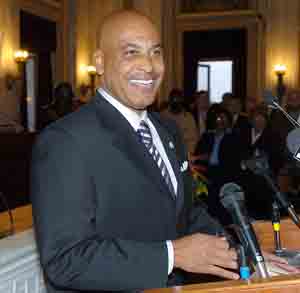 Trenton Mayor Douglas Palmer appeared before the U.S. House of Representatives committee on Energy Independence and Global Warning on Thursday, Jan. 15, 2009. The hearing was on "Green Jobs, Efficiency Opportunities in the Economic Stimulous Package: Creating Opportunities for All"
Mr. Chairman and Members of the Committee, I am Douglas Palmer, Mayor of Trenton and
Past President of The United States Conference of Mayors. We thank you for this opportunity
to appear today on behalf of The U. S. Conference of Mayors, the national organization of the
nation’s mayors who represent the more than 1,100 U.S. cities with a population of 30,000 or
more.
On behalf of the nation’s mayors, we also want to express our appreciation to the Committee,
especially Chairman Markey and Ranking Member Sensenbrenner, for holding a field hearing
with mayors during the Conference’s Mayors Climate Protection Summit in Seattle,
Washington. At that time, I was pleased to participate in this hearing to discuss the mayors’
energy and climate efforts, most notably our call for enactment of the Energy Efficiency and
Conservation Block Grant (EECBG) Program, which is a top priority of the nation’s mayors for
the economic recovery package.
Immediately following your hearing, Congress enacted the EECBG program as part of the
Energy Independence and Security Act of 2007, thanks to your leadership, Mr. Chairman, and
that of the Members of this Committee and others throughout the Congress.
Since that time, the nation’s mayors through the Conference of Mayors, joined by the National
League of Cities and National Association of Counties, have spent many months urging
Congress to fund this program so we can accelerate our nation’s efforts, through communitybased investments and other initiatives, to grow green jobs and a greener economy. We strongly believe an EECBG funding commitment is most appropriate and timely for inclusion in the economic recovery plan that will soon be debated in this Congress.
Mr. Chairman, you asked for testimony today on these three priority concerns before the
Congress:
1. How has the recent economic downturn affected cities’ efforts to meet fiscal and
environmental goals?
2. Can a “green” economic recovery package create jobs and stimulate the economy
while also generating environmental benefits for localities?
3. How should stimulus funds between states and cities be allocated?
The reality at the local level is the economic downturn is having profound effects on our fiscal
and environmental goals.
We strongly believe, and there is evidence that supports this, that the economic recovery plan
can create jobs and stimulate the economy, while providing significant environmental benefits
for local areas.
And, by design, the EECBG program resolves questions about states versus localities by
offering a balanced approach to the distribution of funds between states and cities and
counties, building upon a proven federal delivery system that HUD has used for three decades
to assist local and state community development efforts.
Economic Downturn and Impacts on Local Fiscal & Environmental Goals
Mr. Chairman, our nation’s cities and their metro areas are the engines of our national
economy. Our 363 metro areas are home to 86% of U.S. employment, over 90% of wage
income and nearly 90% of our gross domestic product.
Therefore, without the economic recovery of our cities and metros, there can be no U.S.
recovery.
Unfortunately, our cities and these larger metro economies are facing the brunt of the current
economic downturn. This weekend, the Conference at its Winter Meeting will release a
forecast of metro unemployment for 2009, prepared by Global Insight.
The news will not be good. Almost all metros will see significant job declines in 2009, and an
amazing number of our metro economies will experience no employment gains for the decade.
With your permission, I would like to enter this report for the record of the hearing after its
release.
Couple this jobless picture with a significant loss in our tax base due to falling real estate
prices, and cities are left with almost no fiscal capacity to expand existing … or start new …
initiatives on climate protection, energy efficiency and energy independence, areas that are
absolutely essential to building a competitive economy for the future.
One statistic bears this out. In 2008 alone, we estimate that home values will have dropped
8.8% or $1.73 trillion. This unprecedented decline, coming after years of steady growth in real
estate values, has been especially disruptive to cities and other local government finances.
Consider that about one half of all local government revenues are linked in some way to real
estate, whether it is valuations for local property taxes to revenues and fees from real estate
transactions.
Compounding this dire situation is the fact that many state governments are cutting or
eliminating general aid and other programs to cities and local governments that we have
traditionally relied upon to deliver basic services.
In my many years of service in local elected office, mostly as Mayor of Trenton, I have never
seen anything that comes close to approximating the fiscal conditions my city is now facing.
Foreclosures are at record levels, local revenues are down substantially, and looming state
budget cuts are at unprecedented levels.
More than one year ago, I set forth my “Trenton Green” initiative to put my city on a path to
green collar careers, new green jobs and a greener economy. We went to work on a number of
energy conservation, energy efficiency and renewable energy production initiatives, with a
particular emphasis on developing green collar careers for our citizens. It is an effort that
reaches out broadly to our citizens and embraces new partnerships with the private sector,
non-profit agencies, the local utility, state government and its agencies, and the federal
government.
One year later, I am confronting unprecedented fiscal challenges, forcing the City to cut our
workforce and the autonomous library to trim back its hours, among a broad array of tough
decisions, all to align available revenues with future expenditures. There is no end in sight, and
it is still getting worse. This means for my city, and so many others throughout the U.S., we are
already losing ground on our current energy and climate initiatives, with the potential for even
greater retrenchment in coming months.
Early last year, anticipating these conditions, I directed the Conference’s Mayors Climate
Protection Center to undertake a survey examining some of these fiscal challenges.
Conducted in May 2008, nearly three in four mayors – at that time – were already reporting
economic problems, specifically local revenue constraints, which were adversely affecting their
financial commitments to local initiatives to help meet the goals set forth in the Mayors Climate
Protection Agreement. This was the period of time during the run up in oil prices, notably
gasoline and diesel fuel costs, that only pushed a weakening U.S. economy further into
decline, reminding us of the critical need to reduce our dependency on foreign energy supplies
by conserving and using our energy resources more efficiently and by shifting to greater
reliance on renewable energy sources here in the U.S.
Especially relevant to the need for funding the energy block grant program in the economic
recovery plan was the finding that 82 percent of cities reported that lack of resources was the
single largest obstacle to making progress on their local energy and climate goals. These
results were prior to the economic meltdown and job losses that we experienced throughout
the fall of last year.
The bottom line, Mr. Chairman, is that we are in the midst of a perfect economic storm and we
simply do not have the resources to maintain current services. New energy and climate
programs that are in the near-term and long-term interest of the nation and are the key to our
future prosperity are simply out of reach, unless we have energy block grant resources to help
us build on the momentum that we have begun through the Mayors Climate Protection
Agreement and other initiatives.
On the macro level, we project that 94% of our nation’s economic growth will occur in our
metro areas over the next 20 years, and we know that long-term productivity of recovery
spending is greater when it is invested in locally-based projects and activities where economic
growth will occur. Mr. Chairman, 85 percent of job losses during this recession will occur in
our cities and their metro areas. Since these are the areas that have carried U.S. economic
growth, this is an alarming development. As such, we need a National Recovery Plan that
invests directly into these areas. Simply put, we need to create jobs where the unemployed
are, and we can create jobs in green economy sectors through the energy block grant and
other initiatives.
“Green” Economic Recovery Plan: Jobs, Stimulus & Local Environmental Goals
Mr. Chairman, mayors have been consistent in our views about the opportunity and the
necessity to put this nation on a path to a green economy. The economic plan you develop
can and must make the critical investments that will move the nation toward a greener
economy. This has certainly been a central theme of the mayors’ advocacy of the
Conference’s MainStreet Economic Recovery Plan.
First released in early November, the “ready-to-go” effort identified by the nation’s mayors
urges Congress and the new Administration to make a strong commitment to Main Street oriented investments that will create jobs and reinvigorate the economy, while moving the
nation toward greater energy independence and reduced greenhouse gas emissions.
To accomplish this, our plan urges, where possible, the use of existing delivery systems –
meaning those that already exist under current law. Our plan also urges you to focus
resources on existing communities and critical sectors, including energy efficiency and key
infrastructures.
Mr. Chairman, to support this MainStreet Recovery Plan, we are continually surveying our
Mayors on investments that can immediately stimulate job creation from completed projects
before the end of 2010. This weekend, we will release an updated survey of these “ready to go” projects that illustrate the variety and range of investments that could be made in cities all
across the country. Mr. Chairman, this is not an earmark list, rather it is a demonstration of the
capacity of Mayors and their cities to aid in the nation’s economic recovery through a myriad of
investments.
Our earlier findings show that 942 projects have been identified in just these 427 cities for
potential EECBG funding, resulting in a total investment of $6.2 billion and creating 38,732
jobs. This weekend, the Conference will release its updated survey results, based on
responses from 779 cities.
Based on this research, we project that for each $1 billion in EECBG funding, about 10,000
local jobs in our cities would be created, exclusive of the many other direct jobs in
manufacturing and other direct and indirect jobs that will result.
These jobs, funded through the EECBG program, would be created in cities, counties, and
throughout the states by investment in thousands of energy efficiency and renewable energy
production projects. As provided by the law, these projects could include energy retrofits of
public and private buildings in local areas, installation of solar panels or wind turbines for the
production of electricity on local buildings, deployment of new energy distribution technologies
(such as distributed generation or district heating and cooling systems) that significantly
increase energy efficiency, and development of systems to capture and generate power from
methane at landfills.
Allocation of Stimulus Funds between States and Cities
Mr. Chairman, we believe the Energy Efficiency and Conservation Block Grant Program, as
enacted, provides a balanced allocation of funds among major cities and counties and their
respective states, with particular protections for less populated states. This program was
vetted in hearings and deliberations during the legislative debate on the last energy bill. The
net result is a distribution of funds based on relative population shares, which we believe is fair
and balanced. Below is a graphic depiction of the distribution of these funds under the program
as authorized in 2007.
as authorized in 2007.
Closing Comments
Mr. Chairman, the nation’s mayors are “ready to go” with green energy efficiency and
renewable projects that have both short- and long-term benefits. We know that the U.S.
Department of Energy is now finalizing a policy guidance to distribute EECBG funds promptly
and effectively, to ensure this program is ready to contribute to the nation’s economic recovery.
On behalf of the nation’s mayors, we thank you for this opportunity to testify today.
posted by Trentonian at
11:39 AM


0 Comments:
Post a Comment
<< Home