Wednesday, October 29, 2008

Palmer testifies on economic stimulous package
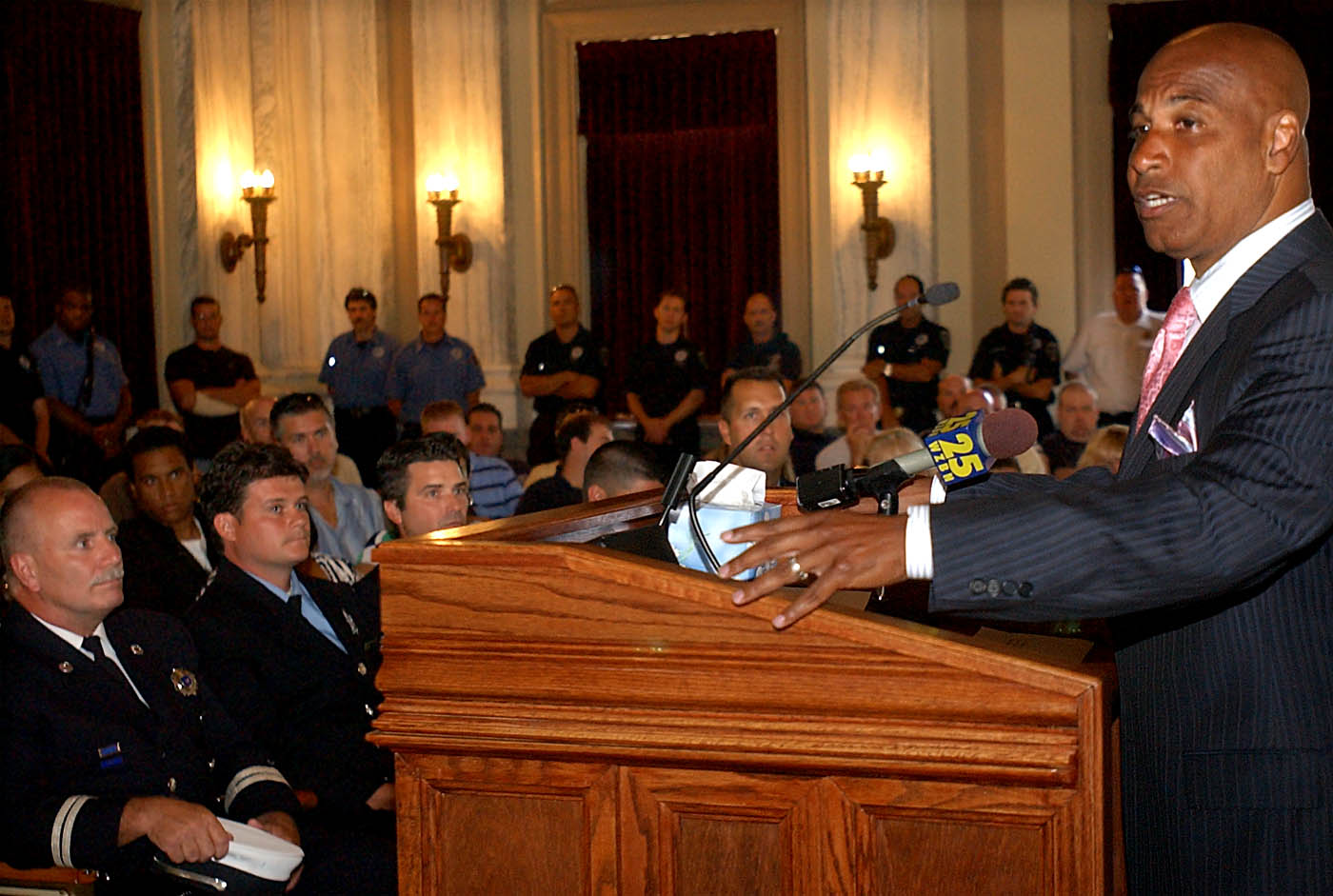
Thank you Mr. Chairman. I am Douglas H. Palmer, Mayor of Trenton and Immediate
Past President of the United States Conference of Mayors. First let me commend you for your
leadership of one of the most important committees in Congress and for your long-standing support of local governments. On behalf of the nation’s mayors, we are pleased that you care enough to hold this hearing and to focus national attention on how the economic crisis is
impacting American families and state and local governments. We also appreciate the
opportunity to discuss how cities across the nation are affected by this crisis and will offer a few
recommendations that we believe will help create jobs and restore economic stability.

As mayors, our citizens ask us every single day: What effect will the economic downturn
have on their jobs, their mortgages, their long-term savings, and their pension funds? Across our
nation, Americans have lost nearly 800,000 jobs in the last nine months. Unemployment
currently stands at 6.1 percent and is projected to reach 7.5 percent next year. Families have lost $2 trillion (20 percent) of their savings. And according to recent reports, retail sales on Main
Street have dropped 1.2 percent in September, foreshadowing a dismal holiday shopping season,
which accounts for approximately 25 percent of annual sales for most businesses.


The fiscal condition of cities has declined significantly since 2007 according to The City
Fiscal Condition Survey, an annual report published in September 2008 by the National League
of Cities. The report states that two of every three city finance officers surveyed in 2008
reported that their cities are less able to meet fiscal needs than in 2007. This compares with 70
percent last year who said their cities were better able to meet fiscal needs than in 2006. The
same report predicts a decline in all three major sources of local tax revenue: property, sales, and income taxes.


Unlike the federal government, local governments can not carry a deficit from one year to
the next. We are required by law to spend no more than we receive in revenues. As a result,
many cities are taking drastic steps to balance their budgets. Let me provide you with a few
examples.


Trenton
Starting with my own city, the financial meltdown, and the domino effect that has
occurred in other sectors, is having a profound effect on the City of Trenton as well as many
other urban municipalities and Main Streets throughout the country.


From a local perspective, Trenton is at a greater disadvantage than many. New Jersey
cities rely heavily upon property taxes as their major source of budget revenue. Cities do not
collect sales, payroll or telecommunications taxes at the local level. They are all collected by the
state. As the capital of New Jersey, Trenton has a very large number of state, county, and federal buildings, many situated on prime property overlooking the Delaware River. We are also a small city land-wise. Almost one third of our 7.5 square miles is owned by State government. Almost 53 percent of all properties are tax exempt. We rely heavily upon State aid to supplement our budget.


To make matters worse, the State of New Jersey is in a fiscal crisis. Local aid has been
reduced significantly, and it is projected that this trend will continue. It is estimated that New
Jersey will have a $4 billion deficit in the next fiscal year. This has translated into a $4.6 million
revenue reduction in State aid to us in the current budget year. In sum, the city’s budget deficit is $25.8 million. As a result, we have instituted a major workforce reduction plan, which includes
layoffs, demotions and the elimination of most personnel vacancies, including 16 police officer
and 13 firefighter vacancies and the demotion of 13 fire captains. In all, we will be eliminating
over 10% of the workforce. This will reduce budget appropriations by $7.4 million, but we will
still have to close the remaining $18.8 million shortfall. If the city cannot find a way to close
this gap, the tax rate will increase by 43 percent.


Additionally, we are struggling to grow our economy and property tax revenues. The
mortgage and credit crisis, compounded by loss of jobs and bankruptcies have resulted in a 46
percent increase in foreclosure filings in the last year. Further, we have had to grapple with the
State using large tracts of prime property for surface parking. Development of these properties
would generate millions of dollars in residential and commercial property tax revenues and spur
the local economy with construction jobs and other more permanent employment. Another major project that will spur the local economy is the redesign of Route 29, a major route along the Delaware River running through Trenton. This road is slated to be converted from a speedway to a boulevard, and in so doing, would join the city with one of its most valuable resources: developable riverfront property. Federal public works dollars would go a long way in providing the capital necessary to make this possible, creating jobs, new construction and new property tax revenues. While Trenton has been hit hard by this crisis, many other cities have also been heavily impacted.


New York
Some economists are predicting that New York and other cities with close ties to the
financial sector will probably suffer the worst. In response to dwindling revenues, New York
City Mayor Michael Bloomberg has pushed through a series of budget cuts over the last year and
a half. So far the city has cut $1.1 billion from last year’s budget, $1.3 from this year’s and $1.2
billion from next year’s. These drastic steps are being taken to close a projected budget shortfall
of $2.3 billion next year, and shortfall of $5.2 billion and $5.1 billion in the following two years.


Bracing for even further declines in revenue from the Wall Street meltdown, Mayor
Bloomberg recently ordered city agencies to come up with another $1.5 billion in cuts. If
approved by the City Council, each agency will be required to reduce its budget by 2.5 percent
this year and an additional 5 percent next year. There is no doubt many critical services will
suffer. The City Department of Education will be cut by more than $580 million. And this
comes on top of the $180 million cuts in public schools last February. The Police Department
budget will also be reduced by $286 million. In addition to the cuts, the Mayor is considering a
mid-year 7 percent increase in property taxes to help balance the budget in future years.


Chicago
The City of Chicago is facing a $469 million budget shortfall. In response, Mayor
Richard M. Daley has proposed laying off 929 city workers and eliminating 1,346 vacant jobs.
His new budget proposal also calls for increasing taxes on parking and sports tickets, and
requiring city workers to take three unpaid days off.


The tax increases come on top of numerous tax increases already imposed. Mayor Daley
explained the budget cuts will mean the city will take longer to hire police officers, to plow side
streets following snow storms, to clean vacant lots and to fill potholes.


Atlanta
In Atlanta, city officials have decided to cut 130 positions in the city’s Fire Department to
help close a $140 million budget gap. Although the Fire Chief has decided not to close any of
the fire stations, firefighters are being redistributed from areas with fewer emergency calls to
areas with more calls. According to the Fire Chief, this move could increase some emergency
response times.


I am sure all will agree that our local Fire Departments provide a critical service and that
response time can make all the difference in the world when it come to saving lives and personal
property. We can only hope the budget crunch that many of our cities are experiencing will
never impede our Fire Departments’ ability to respond to life-threatening emergencies in a
timely manner.


Sacramento
With a budget shortfall projected to surpass $40 million next year due to declining
revenues from sales and property taxes, the city of Sacramento has decided to furlough 889 nonunion employees. This is about one-fifth of the city’s approximately 5,000 workforce. Most of these employees are in supervisory positions. They will be required to take one unpaid day off
per month effective January 1, 2009 and it could continue beyond six months. This will amount
to a 5 percent salary reduction for affected employees.


The cuts will mean fewer police patrols, a decrease in the number of serious crimes
detectives will respond to after hours, and it will take longer to respond to 911 calls. Although
the city is cutting back in an attempt to avoid layoffs, the City Manager has made clear that
nothing is off the table when it comes to future cuts. About 70 percent of the city’s budget goes
to pay labor costs, which makes layoffs a huge target for future cuts.


In summary Mr. Chairman, the economic meltdown sweeping across our nation and the
globe, threatens to subject many local governments to budget shortfalls far into the foreseeable
future. It is clear to us that the economy needs a shot in the arm to nurture it back to a healthy
recovery. Now that Congress has enacted a $700 billion package to bail out Wall Street, we
strongly recommend the enactment of a Main Street Stimulus package. Congress should also
take action to ensure that local governments have access to short-term credit.


Local Government Credit Assistance
Due to the problems in the domestic and global financial markets, state and local
governments are finding it increasingly difficult to access the capital markets at commonly
acceptable rates. Cities across the country are especially having difficulty selling bonds and
accessing short-term credit. State and local government issue short-term instruments for the
same reasons as corporations—to access capital to pay debts until revenues are received, or until
new bonds are issued. We are concerned about recent comments by the Federal Reserve that the newly created Commercial Paper Funding Facility (CPFF) would not assist the tax-exempt,
short-term market.


We strongly recommend that Congress direct the Federal Reserve and the Treasury
Department to work together under the $700 billion Emergency Economic Stabilization Act to
design a facility to provide a funding backstop to the state and municipal government debt
market similar to the recently announced program for commercial paper. Without such action,
states and municipalities will face ever-increasing costs to manage their short-term debt.


Main Street Stimulus
Congress should immediately enact a Main Street Stimulus package that includes
programs that will create jobs, improve the nation’s infrastructure, help small businesses on
Main Street and have a lasting economic and environmental impact. The following programs
should be included in the Main Street Stimulus package:


1. Community Development Block Grants for Infrastructure ($10 Billion)
We’re asking for a $10 billion increase in CDBG to create jobs through: the
construction and improvement of public facilities, streets, and neighborhood
centers; the conversion of school buildings; and assistance to businesses to
generate economic development and job creation.


2. Energy Block Grant for Infrastructure and Green Jobs ($5 Billion)
It is time to move America toward a greener economy and tap the potential to
create millions of green jobs for Main Street businesses and free the U.S.
economy from its dependence on foreign oil. Congress should approve a $5
billion investment in EECBG, which will give cities, counties, and states the
resources to create thousands of energy efficiency and renewable energy
production projects across the nation.


3. Transit Equipment and Infrastructure ($9 Billion)
Our rail and bus systems are being forced to raise fares, cut service, and borrow
funds to address the capital and operating needs. At the same time we are
experiencing a dramatic surge in ridership due to high gas prices. Congress
should fund the purchase of buses, street cars, rail cars and other equipment
needed to create additional capacity; help stabilize fare increases; and restore and
maintain facilities and infrastructure in a state of good repair.


4. Highway Infrastructure ($32 Billion)
To create Main Street jobs and ensure that traffic-congested areas actually receive
funding, Congress must not distribute additional highway stimulus funds based on
the current state-based status-quo system. Instead, the Surface Transportation
Program must be used to distribute highway stimulus funds. This will provide
maximum flexibility to cities, counties, and states in advancing bridge, bus and
rail, and road projects in our nation’s metropolitan areas.


5. Airport Technology and Infrastructure ($1.5 Billion)
The nation’s airport infrastructure urgently needs increased funding to begin
addressing the investment gap in airport capacity, safety and technology. To
create high-paying jobs, assist small businesses and airport retailers, Congress
should fund ready-to-go Airport Improvement projects.


6. Amtrak Infrastructure ($1.25 Billion)
Amtrak is experiencing record ridership across the railroad’s entire system for
intercity passenger rail service. Amtrak connects rural, suburban, and urban
communities in all regions of the nation. Congress should increase federal
funding to make necessary upgrades to tracks, bridges and tunnels, electric
traction, interlockings, signals and communications, and stations on the nation’s
Amtrak system.


7. Water and Wastewater Infrastructure ($18.75 Billion)
Despite the tremendous investment made by local government, the Environmental
Protection Agency estimates that there still is a $500 billion “needs gap” to meet
our water and wastewater infrastructure needs. Congress should allocate an
additional $18.75 billion directly to cities as grants to assist with rehabilitating
aging water and sewer infrastructure, complying with sewer overflow issues, and
promoting source water protection and availability.


8. School Modernization ($7.5 Billion)
America's schools are in dire need of modernization and repair. Every day, many
of our children attend school in overcrowded classrooms with faulty electrical
systems, broken windows, peeling paint and leaking roofs. Congress should
invest $7.5 billion to repair and modernize school buildings in both large and
small city school districts, improve their energy efficiency and equip them with
first-class technology.


9. Public Housing ($2.5 Billion)
The public housing capital funds which supports the capital needs of public
housing, has a backlog of capital improvement needs estimated at $18 billion to
$20 billion. Funding can be used for repair and construction projects, including
safety repairs. Every dollar of Capital Fund expenditures produces $2.12 in
economic return. And many of the vendors used to make repairs and undertake
construction projects are small businesses.es and infrastructure in a state of good repair.


10. Public Safety Jobs ($2.48 Billion)
Recent surveys have found that there is a direct link between the economic crisis
and increasing crime rates. A total of 42 percent of cities in a 124-city survey
have experienced an increase in crime. The survey also found that there are 8.6
percent fewer police officers in the cities surveyed than there were at their peak
staffing levels. To help keep Main Street safe, Congress should add $1.25 billion
to the COPS program to help local police departments put an additional 16,000
police officers on the street; and increase the Byrne Justice Assistance Grant by
$1.23 billion to help keep thousands of police officers on their jobs.


Mr. Chairman, that ends my statement. I am submitting for the record a complete copy of
our Main Street Stimulus plan which discusses in greater detail the programs that I have just
outlined.

Thank you for the opportunity to testify.

Friday, October 24, 2008

Gusciora eyes solar power for new schools

TRENTON – In light of the New Jersey Energy Master Plan’s call for 30 percent of the state’s energy to be produced from renewable sources by 2020, Assemblyman Reed Gusciora has introduced legislation which would mandate that new school construction include solar panels as part of the design.
Gusciora said using solar power in schools would not only help the state meet its energy goals, but also would save taxpayers money and promote growth in the “green jobs” sector.

“With the state prepared to invest $3 billion in new schools, it makes sense to ensure solar energy is considered from day one,” said Gusciora (D-Mercer). “The initiative will not only promote renewable and efficient energy, but lead to the creation of countless new ‘green’ construction jobs. In addition, local property taxpayers will save as energy bills drop from schools going off-the-grid.”

The energy master plan unveiled by Governor Jon Corzine Wednesday calls for the state to derive 30 percent of its electricity from renewable energy and cut statewide energy use 20 percent by 2020. Schools are prime candidates for solar energy due to their expansive, flat roofs and location in more open areas.

Other government buildings, such as the National Guard Armory in Lawrenceville, currently use solar power to offset their consumption and pump surplus energy back into the commercial grid. Retrofitting buildings can be expensive, but costs are dramatically reduced if it is part of the design.

“Placing solar panels on schools can help replace our dependence on fossil fuels with clean, renewable energy,” said Gusciora. “This is a solid investment in our future. Not only can we give kids better schools to learn in, we can also create a greener environment for them to live in.”

The bill has been referred to the Assembly Education Committee.

Burlco Dems demand Republicans cease efforts to thwart free speech

MOUNT LAUREL - Democrats for Freeholder Chris Brown and Mary Anne Reinhart are demanding that Freeholder Director Fenton immediately cease and desist using the power of the Freeholder Board to protect one of Burlington County's most lucrative patronage pits.

Both Brown and Reinhart find it reprehensible that the Burlington County Republican Freeholder Board is pressuring the Prosecutors Office to interfere in a local Cinnaminson election.

"Cinnaminson government has long been a lucrative business for Republican donors and insiders," said Chris Brown. "Instead of allowing Cinnaminson residents a voice, the Freeholder Board is using Gestapo tactics to protect their local elected officials from being held accountable. The decision of the Cinnaminson Committee to disband the local dispatch is an issue that deserves lively debate – no matter which side of the fence you are on. Fenton and the Freeholders are trying to crush that debate."

"This is the same Freeholder Board that remained silent, even as one of their top donors stole $2.7 million from the taxpayers' pockets," said Reinhart. "It took the US Attorney to finally bring Bob Stears to justice, meanwhile the Freeholder Board sat silent."

Burlington County Democratic Chairman Rick Perr said the sudden interest in a local election is puzzling, especially considering the Republicans long history of silence.

"Never once has the County Dispatch been questioned or attacked, everyone knows the men and women who operate our 9-11 call centers are dedicated employees," said Perr. "The issue in Cinnaminson is simple; was the decision made by the Township Committee to disband local dispatch instead of cutting the millions of dollars the Township pays to political donors a wise decision."

"This is not a public safety issue or a County issue. This is an issue about two Committeemen who went against the will of the voters. They made the decision and they now need to own it. They should stand up to the voters and explain their decision, not hide behind a politically motivated prosecutor."

Perr, who was the first to uncover Bob Stears' plot to rip off the bridge commission, said the code of silence is what has exacerbated the crisis of corruption in Burlington County.

"State Senator Diane Allen tells the newspapers she was pressured to loan money to finance Burlington County campaigns and yet the Freeholder Board sat silent.

"Senator Allen's Chief of Staff states that she feels that Chris Baxter, a lawyer who donates to the Burlington County Republicans, has provided poor work product to the Board of Social Services yet still makes tens of thousands of dollars, and the Freeholders came out and supported Baxter – without investigating those claims."

Perr also pointed out that there are a lot of close ties between Cinnaminson and the Paulsen's 20 – a group of 20 individuals who loan hundreds of thousands of dollars each year to fund Burlington County Republican campaigns. These same individuals have been rewarded with tens of millions of dollars in government contracts, salaries and pension credits.

Richard Stroebel and Jim Bristow are both from Cinnaminson. Bristow has even been referred to as the uber boss of Cinnaminson politics.

The engineering firm Remington and Vernick, who was accused earlier this month by the Burlington County Times of using a political action committee to increase the amount of money they donate to Freeholder candidates, has made over $2 million dollars from Cinnaminson government in just the last two years.

Capehart and Scatchard, the law firm of former Republican Chairman Glenn Paulsen, has also made tens of thousands of dollars from the Cinnaminson government.

"The politicization of the Prosecutor's office by the Freeholders is reminiscent of George Bush's and Karl Rove's use of the Justice Department to promote their political agenda. We've seen it happen in Washington, now we are seeing it happen in Burlington County. One has to wonder what it is that they are trying to protect. Past experience dictates that protecting the residents' pocketbooks is not their number one goal."

Monday, October 13, 2008

Poll: Obama's lead declines

UTICA, N.Y. – Democratic Party presidential nominee Barack Obama slipped back into a statistical dead heat with Republican Party nominee John McCain, but still holds the advantage over McCain, the latest Reuters/C-SPAN/Zogby likely voter poll shows.

In this latest report, McCain gained eight-tenths of a point, while Obama lost one full point.
While the worldwide economic system underwent dramatic turmoil last week, the poll shows the presidential race remarkably unchanged overall at the end of the first full week of daily tracking. Through the week, Obama has always held a small lead, as large as 6.1 points (on Saturday) and as little as 1.9 points (last Wednesday).

The rolling telephone tracking poll included a sample of 1,206 likely voters collected over the previous three 24-hour periods spanning four calendar days – approximately 400 per 24-hour period from Oct. 9-12, 2008.

Obama retains a substantial 17-point lead among independent voters, but that edge receded from 21 points yesterday. In terms of securing their political bases, both Obama and McCain are doing well. Among Democrats, Obama wins 86% support, while McCain wins 88% support among Republicans.

Three Day Tracking Poll 10-12 10-11 10-10 10-9 10-8 10-7 10-6

Obama 47.9% 48.9% 47.6% 47.6% 47.8% 47.1% 47.7%

McCain 43.6% 42.8% 43.8% 43.4% 44.2% 45.2% 45.3%

Others/Not sure 8.5% 8.3% 8.6% 9.0% 8.0% 7.7% 7.0%

Obama and McCain remain tied among men, while Obama leads by nine points among women.
Among those who consider themselves members of the investor class, McCain leads by a 49% to 44% margin. This McCain edge among investors is the same as yesterday but far less than the percentage by which President George W. Bush won four years ago. Among non-investors, Obama leads by a 51% to 39% margin, down slightly from yesterday.

Those who say they are liberals support Obama by a 83% to 11% margin over McCain, while McCain leads among conservatives by a 72% to 17% edge. Among moderates, 59% support Obama, while 35% support McCain.

The poll was conducted by live telephone operators in Zogby’s in-house call center in Upstate New York and carries a margin of error of +/- 2.9 percentage points.

Wednesday, October 8, 2008

Obama Remains Slow and Steady

By Andria Y. Carter
Online Editor

Slow and steady is the strategy that continues to work for Democratic presidential candidate Barack Obama. Despite the stepped up criticism by his Republican counterpart, Obama remains cool and even.

Obama didn’t have much work to do in this debate other than to continue to lay out his domestic and foreign policy. He was focused and knew his opponent well. John McCain did not.

Political pundits noted right away that John McCain had improved his performance and answered the questions better regarding domestic issues, but Obama continued to slap him back each time McCain attempted to show why this “young upstart” is not ready to be president.

As Obama and McCain traded barbs all night long the one thing that stood out the most is McCain is an old time campaigner and Obama is speaking to a new technological and global audience. McCain can’t keep up.

People are listening to what each candidate is saying. But they are also seeing and comparing the traditional campaigner to the “new guy.” McCain appeared old and confused and did not help his cause when he referred to Obama as “that one.” Meanwhile Obama remained steady and indestructible.

Did McCain have his Bob Dole moment? Is his campaign over because he can’t get it together? Will McCain’s vice presidential candidate Sarah Palin increase her attacks?
Who is to say, but they need to take a lesson from Obama.

Although the Nashville debate is now that anyone expected. Even I had great expectations for a nock down, drag out slug fest. Instead we go dull, boring with a great one line moment that will affect a candidate during his last days of the campaign.

Obama’s campaign has and remains successful because he has remained cool, rational and on point. From day one the attacks and scrutiny of Obama has been intense and the most ever endured by a candidate. Anyone associated with him have gone under similar scrutiny which many find shocking. But being a black man in America means you are held to a higher standard than most.

McCain’s attacks last night kept that steady drumbeat of distrust going, pounding out that fear factor twisting Obama’s plan attempting to show the “young upstart” knows nothing.

The “young upstart” proved last night he does know something and was able to put his elder colleague in his place while maintaining a steady and cool attitude.

Tuesday, October 7, 2008

Obama takes lead in national poll; but still no clear advantage

UTICA, N.Y. - The race for President of the United States remains far too close to call between Democrat Barack Obama and Republican John McCain as the contest enters its last four weeks, and with a pair of crucial debates immediately ahead, the first report of the fall Reuters/C-SPAN/Zogby daily tracking telephone polls shows.

The survey, including a three-day sample of 400 likely voters collected over each of the previous three days - Oct. 4-6, 2008 - shows that Obama holds a slight advantage amounting to 2.4 percentage points over McCain. This represents a bit of a recovery by McCain, who had been sliding in some polls before his running mate, Sarah Palin, put in a strong performance in her one and only debate performance last Thursday. Though a Zogby poll showed that Democratic vice presidential nominee Joe Biden actually won that debate, it also showed Palin far and away exceeded expectations, and that has apparently helped stop McCain's decline in the polls.

Three Day Tracking Poll 10-6
Obama 47.7
McCain 45.3
Others/Not sure 7.0

The Reuters/C-SPAN/Zogby poll, conducted by live telephone operators in Zogby's in-house call center in Upstate New York, included a total of 1,237 likely voters nationwide, and carries a margin of error of +/- 2.8 percentage points.

Candidates Doing Well Among Their Own Party Members

The two candidates are doing well at attracting support from their own partisans - Obama is winning 86% of the Democratic Party support and McCain is winning 85% of the Republican Party support - but Obama has the edge among independent voters. He leads McCain among independents, 49% to 42%.

Obama wins support from a slightly higher percentage of conservative voters than McCain is winning from liberal voters, but the advantage is small.

Obama's edge also comes from a lead among women, where he holds a 51% to 42% advantage. McCain leads among men, but only by four points - 49% to 45%.

Among white voters, McCain leads Obama by a 55% to 39% margin, while Obama wins 90% support among blacks and leads among Hispanic voters by a 57% to 30% margin.

Both candidates have a positive favorability rating from likely voters nationwide, but McCain is seen a slightly more favorable light, the survey shows. While 57% said they have a favorable overall opinion of McCain, 55% said they held a favorable overall image of Obama. Among independent voters, an identical 57% hold a favorable view of both candidates.

With much made of the "new" voter this year, it is interesting to note that Obama has a notable edge over McCain among those who have registered to vote in the last six months. While 63% of those voters said they have a favorable opinion of Obama, just 47% said the same of McCain. It is worth noting that new voters tend to skew a bit younger, which are age demographics that favor Obama, the survey shows.

Public Remains Convinced U.S. Headed in Wrong Direction

No surprise in the poll that a vast majority feel the country is headed in the wrong direction. In this first of the daily tracking polls of the last month of the race for the White House, just 17% said the U.S. was headed in the right direction, while 74% said it was on the wrong track. The rest said they were uncertain. Republicans were decidedly more upbeat than Democrats - 28% of GOPers said things were on the right track nationally, while just 8% of Democrats agreed. Independents were somewhere in-between, as 14% said things were headed in the right direction.

Daily Tracking Continues

This daily tracking telephone poll will continue each day until the Nov. 4 election, keeping in touch with the daily twists and turns in the race for the White House. The running poll of about 1,200 likely voters consists of three days of polling - about 400 from each of the last three days. With each new day of polling that is folded into the poll, the oldest third of the survey is replaced with the fresh data, so the poll "tracks" movements and events in the campaigns. Keep up to date every day by visiting www.zogby.com.

McCain "Blatantly Distors" Obama Comment on Military

WASHINTON, D.C. - The Democratic National Committee today updated the Count the Lies counter after the Washington Post reported that John McCain's ad "blatantly distorts Barack Obama's words in an effort to paint him as callous about the role of the U.S. military." In reality, Barack Obama said "the opposite of what is portrayed in this spot."

Since John McCain locked up his party's nomination and promised to run a respectful campaign in February, at least 107 independent, non-partisan fact checks have to debunked McCain campaign lies. Visit www.democrats.org/CountTheLies to see the updated Count the Lies counter.

Washington Post: McCain Spot Distorts Obama Comment About Military. "This John McCain ad blatantly distorts Barack Obama's words in an effort to paint him as callous about the role of the U.S. military. The commercial truncates a comment that Obama made to a voter in New Hampshire in August 2007.

According to the Associated Press, the senator from Illinois brought up Afghanistan when asked whether he would withdraw troops from Iraq to fight terrorism elsewhere: 'We've got to get the job done there, and that requires us to have enough troops so that we're not just air-raiding villages and killing civilians, which is causing enormous pressure over there.' In short, Obama was saying he wanted to avoid just air-raiding villages and killing civilians, not that this was all that American troops were doing. His meaning was the opposite of what is portrayed in this spot." [Washington Post, 10/7/08: http://www.washingtonpost.com/wp-dyn/content/article/2008/10/06/AR2008100603082_pf.html]
###

Rush Holts comments on NJ voting machine decision

WASHINGTON - Rep. Rush Holt (NJ-12) issued the following statement today in response to the New Jersey Superior Court ’ s failure to release the report of computer security experts describing what they found in their analysis of two of the voting machines of the type used in 18 of New Jersey ’ s 21 counties.

“It is regrettable that the report, due by court order to be released on Thursday , has been suppressed at the request of the voting system vendor. Clearly, if the report vindicated the equipment, the vendor would be eager for it to be released. The fact that the vendor requested that it not be released suggest s it does not want New Jersey voters to know what it says about the equipment – equipment that failed in the Primary, resulting in the inspection order.

The Court’ s decision is very troubling, as it leaves voters with virtually no choice but to conclude that there is something wrong with the machines, that the vendor does not want us to know what it is, an d that the court is allowing it to be kept secret."

Monday, October 6, 2008

NJ Legislators Speak their Minds on the Economy

TRENTON – Assembly Democrats released the following statements today as Assembly committees held unprecedented hearings on how to ensure New Jersey workers and businesses emerge strong from the national economic crisis:

Assembly Speaker Joseph J. Roberts Jr. (D-Camden):
“We’re already taken critical steps to revive the state’s economy, but this crisis now requires unprecedented focus. New Jersey gets hit hard by Wall Street’s struggles, but we also need to look out for our hard-working lower- and middle-income families and small businesses struggling to get by and wondering what may come next.”

Assembly Majority Leader Bonnie Watson Coleman (D-Mercer):
“We’ve heard a lot about how this crisis is hurting Wall Street, but not enough about how this crisis is hurting average New Jerseyans already struggling to pay their mortgages and rent, buy groceries, fill the tank, pay the doctor and save for retirement.”

Assembly Budget Chairman Lou Greenwald (D-Camden) on plans to enable businesses to write-down net operating losses for up to 20 tax years, as opposed to the currently allowed seven years:

“This is aimed squarely at the small businesses that are the lifeblood of this state. Small businesses need every chance to stay competitive, invest in their operations and retain precious jobs. This move builds on other vital steps we’ve taken to ensure businesses that employ our residents remain strong and is just what these tough times require.”

Assembly Housing and Local Government Committee Chairman Jerry Green (D-Union) on home mortgage and foreclosure concerns:

“Homeownership has long been the American dream and is key to helping foster stable and vibrant neighborhoods where families feel safe and children prosper. The ongoing home mortgage and foreclosure crisis has threatened not only a way of life for many New Jerseyans, but their future. Answers aren’t easily found, but we must strive to find them as we work to keep the American dream alive for so many New Jerseyans.”

Assembly Telecommunications and Utilities Chairman Upendra Chivukula (D-Somerset) on plans to help residents pay heating bills while also promoting new jobs from alternative energies:
“With cold weather approaching, the national upheaval could not have come at a worse time for consumers. We must ensure that New Jerseyans across the spectrum will be able to literally weather this economic crisis while keeping an eye on the emerging technologies that can fuel the state in the future.”

Assembly Health and Senior Services Chairman Herb Conaway (D-Burlington) on health care worries:

“New Jersey’s families already have enough to worry about without having to fear that their very health could push them even further toward the edge. The state already has a strong set of programs available to protect our most vulnerable residents. However, we need to ensure that system does not collapse under the weight of having to take care of countless new residents caught in the economic storm.”

Assembly Financial Institutions and Insurance Committee Chairman Gary Schaer (D-Passaic) on the mortgage and foreclosure crisis:

“For an increasing number of New Jersey families, the ongoing woes in the mortgage industry have combined with the recent Wall Street meltdown to create a perfect storm that threatens their very ability to stay in their homes. Homeowners and prospective home buyers need confidence that their dreams of being able to afford a place to call home will not dissipate in the current crisis. Working together, government, business, and consumers all can emerge from this situation intact.”

Assembly Human Services Chairwoman Sheila Y. Oliver (D-Essex) on social service worries:
“We must protect residents from the fallout of the recent economic collapse by shoring-up the safety net of essential services. New Jersey depends on federal aid to help fund its many programs. Already strained state taxpayers should not be left on the hook to cover every additional penny needed to help every family affected by this crisis.”

Assembly Environment and Natural Resources Chairman John McKeon (D-Essex) on alternative energies:

“ With prices for natural gas and oil continually climbing, now is the time to look at whether non-traditional sources of energy can help stabilize or even lower utility bills for residents and businesses The current crisis presents an opportunity for us to collectively plan for our long-term energy needs.”

Assembly Commerce and Economic Development Chairman Joseph Vas (D-Middlesex) on a series of bills he sponsored to further improve the state’s business climate:

“New Jersey has the strength to successfully weather the worst of this financial storm, but only if we continue to take decisive action. We must do whatever we can to keep New Jerseyans gainfully employed and continue making the state a great place to do business.”

Assembly Law and Public Safety Committee Chairman Gordon Johnson (D-Bergen) on federal and state oversight of the financial services industry:

“The time has come for tough measures to crack down on those whose reckless actions contributed to the country’s recent economic meltdown and put the savings of New Jersey families at risk. With Wall Street having such an impact on our state, New Jersey needs to take a stand that the old, anything-goes way of banking cannot be allowed to continue.”

Assembly Regulated Professions Chairman Vincent Prieto (D-Hudson) on enhancing consumer protections:

“A $700 billion bailout of Wall Street is not going to be enough to ensure that New Jersey’s working families have every opportunity to get back on their feet. Rescuing Main Street will take a meaningful commitment from this Legislature toward enacting measures that clarify and strengthen the state’s authority to protect consumers.”

Assemblywoman Pam Lampitt (D-Camden) on boosting the economy through green jobs:

“ We need to stop looking at wind and solar power as novelties and start viewing them as a viable, home-grown energy industry that can create new jobs here in New Jersey. Actively promoting the expansion of alternative energy can be a win for ratepayers, a win for the economy and a win for the environment.”

Friday, October 3, 2008

He Did his job

Sen. Joe Biden proved during last night's vice presidential debate that he not only is prepared to serve as VP, he understands what the job entails.

The vice presidential candidate proved last night once and for all why Sen. Barack Obama chose him as his running mate. Despite tremendous pressure to attack Sarah Palin he showed restraint and stuck to the issues. But more importantly he did more for the equal treatment of the sexes than Sarah Palin did. The emotion he showed discussing the needs of being a single parent and wondering whether your child will live or die was good. You can't imagine that.

Despite what the Republican pundits say today their candidate was not ready. If you are going to govern and be a top leader of the free world you must know the issues. Sarah Palin proved last night that she knows how to stay away from topics and stick to talking points. Biden stuck to his talking points too but he also provided the reasoning behind the issues, the history and the clarification when a point needed greater clarification.

Sarah Palin ran from her job and failed in this aspect.

Biden proved he is ready for the job, Palin did not.

Wednesday, October 1, 2008

Presidential Candidates Answer IFA Questions

WASHINGTON, D.C., — In an exclusive to Franchising World, Presidential candidates Barack Obama and John McCain have outlined their views on issues important to the franchise industry, the International Franchise Association (IFA) announced wednesday.

The full text of the answers to questions submitted this summer will appear in the October issue of Franchising World , IFA’s monthly magazine and is accessible today at www.franchise.org. The October issue also marks the debut of the digital version of the magazine, making it more accessible to IFA members and others interested in franchising.

“This is a critical election for our country,” said IFA President & CEO Matthew Shay. “It is important that the franchise community know where the candidates stand on key issues important to the industry. We are pleased that both campaigns participated in this important exchange of information so that our members can make informed choices in November.”

Selected excerpts from the Franchising World article are below.

On ensuring that franchised businesses thrive:

McCain: “It is a terrible mistake to raise taxes during an economic downturn. Under my [tax] plan, we will preserve the current low rates as they are, so businesses large and small can hire more people. We will double the personal dependent exemption from $3,500 to $7,000 for American families. We will offer every individual and family a large tax credit to buy their health care, so that their health insurance is theirs to keep even when they move or change jobs. And we will lower the business tax rate, so American companies can open new manufacturing plants and create more jobs in this country, instead of going overseas to flee the second-highest tax rate in the world.”

Obama: “ I recognize that small businesses are an essential ingredient to economic growth and United States productivity. I will ensure that small businesses continue to thrive through several policy mechanisms. I will help small businesses raise capital by exempting investments in small and start-up businesses from all capital-gains taxes. I will cut taxes for corporations that create jobs in America. I will provide a $500 “Making Work Pay” tax credit to almost every worker in America, which benefits self-employed small-business owners in particular who otherwise pay both the employee and the employer side of the payroll tax. Third, I will help small businesses get the tools and the capital that they need to innovate and thrive. In the Senate, I cosponsored the bipartisan Small Business Lending Reauthorization and Improvements Act. This bill expands the U.S. Small Business Administration’s loan and micro-loan programs which provide start-up and long-term financing that small firms cannot receive through normal channels.”

On health insurance reform:

McCain: “My approach toward helping small businesses that cannot afford to provide their employees with health insurance is not to burden those small businesses, but to help their employees. I will build on the current system to provide American families with a $5,000 refundable tax credit ($2,500 for individuals) to purchase insurance that fits their unique needs. I will work closely with states to create Guaranteed Access Plans that will ensure quality coverage to individuals who are otherwise unable to find coverage due to high premiums. GAPs will have reasonable limits on premiums and offer help for low-income Americans.”

“I strongly oppose mandates on employers, especially 'play or pay' mandates forcing employers to provide employees with health insurance, which would lower wages and force employers to eliminate jobs. For example, Barack Obama’s plan would require a business with 20 employees who had families to incur roughly a quarter of a million dollars in health-insurance costs and would mandate what the terms of those health-insurance plans needed to be. He has since proposed a tax credit to try to offset these burdens, but even his own new proposal would only cover half the cost burden, would only apply as a tax credit, and would not ease the cash-flow burden of his plan on the business operator.”

Obama: “I will reduce the burden on small businesses in our economy by offering a new small-business health-tax credit to help small businesses provide quality health care to their employees. This small-business health tax credit will provide a refundable credit of up to 50 percent on premiums paid by small businesses on behalf of their employees. This health-care reform plan also includes other initiatives to reduce health-care costs for small businesses. This plan creates a new national health insurance exchange to allow small businesses to buy low-cost, high-quality health plans for their employees. This proposal will allow small businesses to take advantage of a larger shared-risk insurance pool, a priority that the IFA has been advocating for years.”

“My plan will also reimburse employer health plans for a portion of the catastrophic costs they incur above a threshold if they guarantee such savings are used to reduce the cost of workers’ premiums. This reimbursement is particularly important for small-business plans, which can be overwhelmed by the costs of catastrophic expenditures for even a single employee. Finally, this plan also invests in aggressive cost reduction measures including the broad adoption of standards-based electronic health-information systems, and other value-increasing innovations improving chronic care management, and increasing insurance market” competition.

On immigration reform:

McCain: “I, and many other colleagues, twice attempted to pass comprehensive immigration legislation to fix our broken borders; ensure respect for the laws of this country; recognize the important economic contribution of immigrant laborers; apprehend those who came here illegally to commit crimes; and deal practically and humanely with those who came here, as my distant ancestors did, to build a better, safer life for their families, without excusing the fact they came here illegally or granting them privileges before those who have been waiting their turn outside the country. I don't want to fail again to achieve comprehensive immigration reform. As part of this reform, I will implement temporary-worker programs that will reflect the labor needs of the United States in both the high-tech and low-skilled sectors while protecting the employment opportunities for U.S. workers. I also believe we must establish a user-friendly system employing a limited set of secure documents that contain biometric data and are electronically verifiable to check a worker’s identity. This system should be secure and provide responses to employer inquiries in a prompt and timely manner to provide both the employer and employee security in their hiring decisions.”

Obama: “I support comprehensive immigration reform that includes an earned path to citizenship for the undocumented. As president, I will put comprehensive immigration reform back on the nation's agenda during my first year in office. We must create an immigration system that strengthens our security while reaffirming our heritage as a nation of immigrants. There are millions of people living in the shadows who would like to fully embrace our values and become full members of our democracy. For the millions living here illegally but otherwise playing by the rules, we must encourage them to come out of hiding and get right with the law. I support a system that requires undocumented immigrants who are in good standing to pay a fine, learn English, not commit crimes, and go to the back of the line for citizenship. After all those conditions are met, they would be granted the opportunity to stay in the United States.”

On death (estate) taxes:
McCain: “Among my disagreements with Sen. Obama lies my concern over the estate tax, which he proposes to increase to a top rate of 45 percent. The estate tax is one of the most unfair tax laws on the books, and the first step to reform is to keep it predictable and keep it low. After a lifetime building up a business, and paying taxes on every dollar that business earns, that asset should not be subjected to a confiscatory tax. I will hold the rate on the estate tax to 15 percent, with a $10 million dollar exemption per couple, so franchise owners can leave the product of a lifetime of labor and love to their children.”

Obama: “We should reform the estate tax in order to completely eliminate estate taxes for 99.7 percent of Americans. To do so, I would freeze the estate tax at its 2009 level of $7 million per couple and index it to inflation after that. The remaining 0.3 percent of estates–the 8,000 wealthiest estates in the country–would still be able to keep a portion of the Bush estate tax cut under my plan. I will use the savings from avoiding outright repeal to help finance tax cuts for tens of millions of working families and small-business owners.”